
Trail Engineering, Air-Down PSI Matrix & Winch Recovery Ratings
Kinetic footprint expansion physics, tire pressure deflation thresholds, Warn winch recovery rigging formulas, and electronic locking differential protocols for GMC AT4 and AT4X overland trucks.
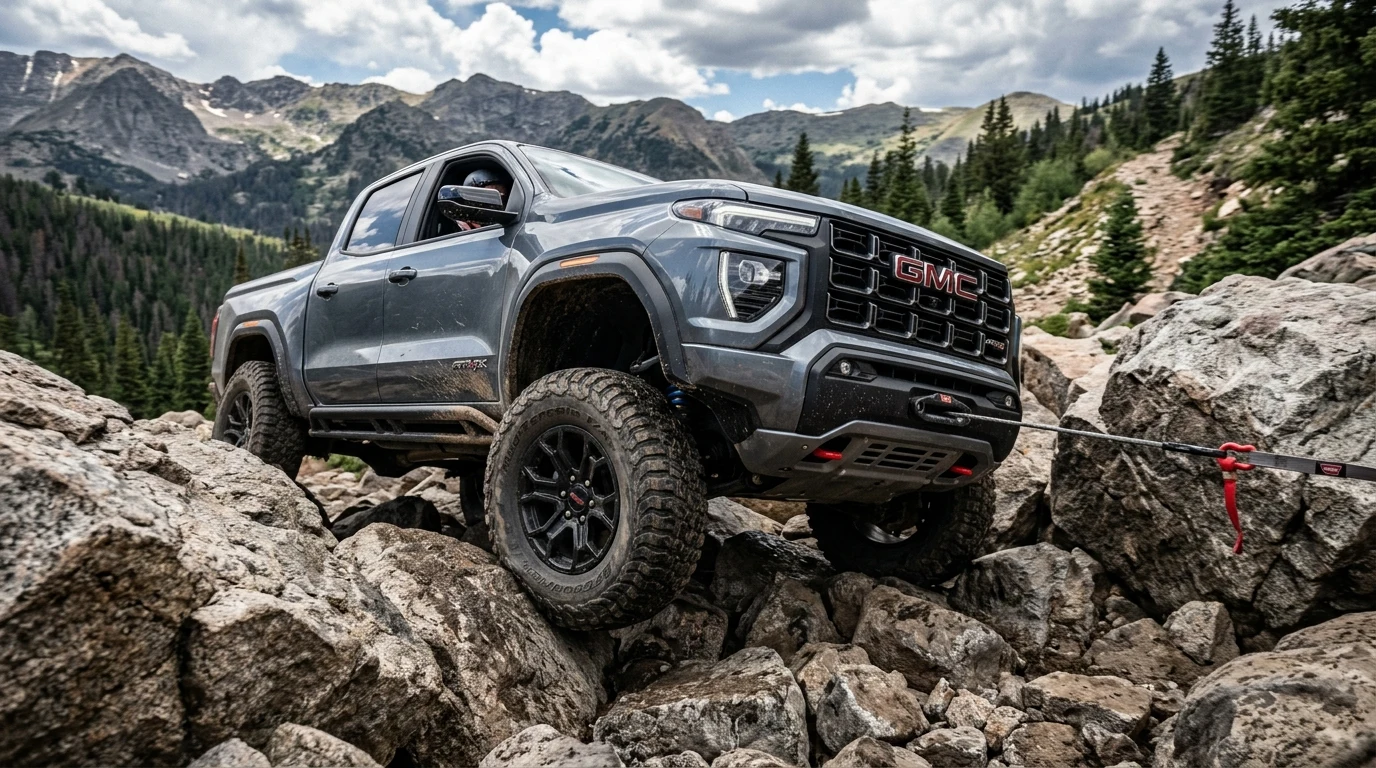
Trail Engineering: Air-Down PSI Matrix & Winch Rigging Calculator
Calculate tire contact patch expansion and safe trail speeds across off-road terrains, and compute exact winch line pulling forces and mechanical advantage rigging for GMC AT4/AT4X recovery.
On standard cast aluminum OEM wheels without internal beadlocks, never air down below 12 PSI. Doing so risks unseating the outer tire bead during lateral rock-crawling side-slopes, resulting in instantaneous air loss.
Standard extraction on firm soil or gravel road.
Winch Capacity Rating >= GVWR x 1.5. In deep mud or steep climbs, suction forces increase resistance beyond vehicle curb weight, requiring either a larger capacity winch or a 2:1 mechanical advantage snatch block pulley.
Recommended Winch & Rigging Setup:
Eaton G80 Mechanical "Gov-Loc" (Sierra AT4)
Standard equipment on Sierra 1500 and 2500HD AT4 rear axles. Operates via internal flyweights and clutch packs. When one wheel spins 100 RPM faster than the opposite wheel, centrifugal force flings the flyweight outward, engaging a cam mechanism that compresses the clutch pack to lock both axle shafts.
Front & Rear Electronic Lockers (AT4X / Canyon)
Exclusive to Sierra 1500 AT4X and Canyon AT4X. Solenoid-actuated dog clutch mechanisms integrated into the front and rear differential carriers. Activated via center console toggle switches in 4WD Low (rear can also engage in 4WD High in Off-Road mode).
The Physics of Airing Down: Contact Patch Growth & Ground Pressure
Airing down off-road tires is the single most effective performance modification for any overland truck. When a tire is inflated to its street placard pressure (38 PSI for a Sierra 1500 or 60/75 PSI for a Sierra 2500HD), the tire carcass behaves like a rigid pneumatic cylinder. The rubber tread makes contact with the ground over a relatively small, concentrated oval area known as the tire contact patch.
As internal pneumatic pressure is reduced from 38 PSI down to 16 PSI, the tire sidewall flexes, allowing the tread belt to elongate along the direction of travel. Crucially, the contact patch does not expand significantly in width—which would increase steering scrub and steering tie rod strain—instead, it elongates longitudinally by 200% to 300%. This provides three profound physical advantages:
By spreading vehicle curb weight across 2.5x more surface area, ground contact pressure drops from over 35 pounds per square inch to under 14 PSI. On soft sand dunes, deep snow, or volcanic silt, the truck floats over the terrain rather than digging downward into ruts.
A pliable, deflated tire tread conforms like a caterpillar track over jagged rocks and tree roots. The rubber envelopes surface irregularities rather than balancing precariously on small friction points, maximizing traction coefficients.
The flexible sidewall absorbs high-frequency trail chatter before it can reach the shock absorbers and frame, dramatically lowering cab vibration and protecting electronic suspension sensors from severe impact shock.
Winch Recovery Engineering: The 1.5x GVWR Law & Synthetic Line Metallurgy
Vehicle recovery in rugged backcountry terrain involves severe static and kinetic friction forces that far exceed the simple rolling resistance of the truck. According to SAE J706 standards and the Society of Automotive Recovery Engineers, the minimum safe winch capacity must equal the truck's Gross Vehicle Weight Rating (GVWR) multiplied by a 1.5x safety multiplier.
For a laden GMC Sierra 1500 AT4 with a GVWR of 7,100 lbs, the baseline minimum pull requirement is:
Winch Minimum Capacity = 7,100 lbs × 1.5 = 10,650 lbs Minimum PullThis makes a 12,000-lb winch (such as the Warn Zeon 12-S or ComeUp Seal Gen2 12.5) the undisputed benchmark for full-size half-ton trucks. However, when a vehicle is buried to the wheel hubs in clay mud, fluid surface tension and suction forces generate up to 50% additional resistance. If buried to the frame rails, suction resistance doubles the required pulling force, easily demanding 14,000 to 18,000 lbs of winch effort.
Master Trail Deflation & Speed Limit Tolerance Matrix
| Trail Terrain Environment | Sierra 1500 AT4 (Cold PSI) | Sierra 2500HD AT4 (Cold PSI) | Canyon AT4X (Cold PSI) | Contact Patch Delta | Maximum Safe Speed | Bead Unseat Risk |
|---|---|---|---|---|---|---|
| Interstate & Highway Driving | 38 PSI | 60 F / 75 R PSI | 35 PSI | Baseline (100%) | 85 mph | Zero Risk |
| Gravel & Washboard Logging Roads | 24–26 PSI | 42–45 PSI | 22–24 PSI | +135% Area | 45 mph | Minimal (Safe) |
| Mud Ruts, Wet Clay & Forest Trails | 18–20 PSI | 32–35 PSI | 17–19 PSI | +180% Area | 25 mph | Low (Safe) |
| Technical Slickrock & Boulder Ledges | 15–17 PSI | 26–28 PSI | 14–16 PSI | +240% Area | 15 mph | Moderate (Avoid high speed) |
| Deep Sand Dunes & Silt Flats | 12–14 PSI | 20–22 PSI | 11–13 PSI | +290% Area | 20 mph | High on hard side-slopes |
Snatch Block Mechanics: Calculating 2:1 Mechanical Advantage
When recovering a heavy 3/4-ton truck like the Sierra 2500HD (GVWR 11,350 lbs) with a 12,000-lb winch, a direct single-line pull can stall the electric winch motor and overheat the internal planetary gear set. By routing the winch line through a heavy-duty snatch block pulley secured to an anchor tree and back to the truck's front recovery hook, the rigging creates a 2:1 mechanical advantage.
This cuts the tension on the winch line in half while doubling the effective pulling power from 12,000 lbs to 24,000 lbs (minus minor friction losses of ~5%). Note that line retrieval speed is halved, and the anchor strap must be rated to withstand the combined 24,000-lb load vector.
Multimatic DSSV Dampers vs Traditional Monotube Shocks
Standard off-road shock absorbers (such as the Rancho monotubes fitted to standard Sierra AT4 trucks) rely on a flexible shim stack covering fluid orifices. Under rapid high-velocity wheel impacts—such as crossing desert washboard corrugations at 50 mph—the shim stack oscillates violently, causing hydraulic oil cavitation, aeration, and thermal fade where damping force degrades by over 40%.
The GMC Sierra 1500 AT4X and Canyon AT4X feature Multimatic Dynamic Suspensions Spool Valve (DSSV) dampers. DSSV technology replaces flexible shims with precision-machined, laser-cut cylindrical spool valves. Fluid passes through mathematically calibrated windows in the spool sleeves, providing position-sensitive hydraulic resistance that never cavitates and maintains 100% damping consistency even when shock fluid temperatures exceed 250°F (121°C).
Frequently Asked Questions: Trail Engineering & Recovery
01What is the optimal air-down tire pressure for a GMC Sierra 1500 AT4 on rocks?
For standard Load Range E (10-ply) or factory standard Load Range C tires on 18-inch or 20-inch wheels, airing down to 15–18 PSI provides an optimal balance. At 16 PSI, the tire's ground contact patch expands by over 240% compared to highway placard pressure (38 PSI), allowing the tread blocks to mold around jagged rock edges and dropping ground surface pressure from 38 PSI down to approximately 14 PSI. On non-beadlock OEM wheels, do not air down below 12 PSI to avoid unseating the outer tire bead during off-camber articulation.
02How do you calculate the correct winch rating for a GMC Sierra 2500HD?
Automotive engineering and SAE recovery standards dictate that minimum winch capacity must equal the Gross Vehicle Weight Rating (GVWR) multiplied by 1.5. A fully outfitted Sierra 2500HD Crew Cab AT4 carries a GVWR of 11,350 lbs. Multiplying 11,350 lbs by 1.5 yields a minimum recommended winch rating of 17,025 lbs. While a Warn 16.5ti heavy-weight winch is ideal for direct single-line recovery, operators utilizing a 12,000-lb winch (such as the Warn Zeon 12-S) must incorporate a heavy-duty snatch block to create a 2:1 mechanical advantage, effectively doubling pulling capacity to 24,000 lbs.
03Is synthetic winch line safer than traditional steel wire cable for truck recovery?
Yes. Modern Ultra-High-Molecular-Weight Polyethylene (UHMWPE) synthetic rope (such as Warn Spydura or Samson Amsteel-Blue) offers a breaking strength exceeding 16,500 lbs at 3/8-inch diameter while weighing 80% less than steel cable. Crucially, synthetic line stores virtually zero kinetic elastic energy under tension. If a synthetic line snaps, it simply drops to the ground; if a steel wire cable breaks under 12,000 lbs of load, it whips violently through the air, capable of piercing steel truck bodies and causing fatal injuries.
04When should I engage the front electronic locking differential on an AT4X?
The front electronic locker should only be engaged when the truck is in 4WD Low, traveling at speeds under 5 mph, and facing an immediate obstacle where one front wheel is airborne or experiencing total traction loss on slickrock or deep mud ruts. Because a locked front differential mechanically forces both front tires to turn at identical speeds, steering effort increases dramatically and the vehicle will resist turning. Disengage the front locker immediately once all four wheels clear the obstacle to restore steering responsiveness and prevent CV axle bind.
Topical Architecture & Expansion Roadmap
Multi-phase engineering roadmap modeling all domain-specific calculations, specifications, and systemic workflows.
Core AT4 Fitment & Clearance Architecture
Verified tire clearances, offset backspacing, and real-time speedometer correction for Sierra and Canyon platforms.
3.0L Duramax LZ0/LM2 & 6.2L L87 Powertrain Systems
Dyno torque curves, Dexos oil specifications, and 10L80 / Allison transmission diagnostics.
Suspension Lift Geometry, Offset & Load Range Ratings
Multimatic DSSV vs Rancho suspension dynamics, leveling kit clearances, and cold inflation pressures.
Towing Capacity, Tongue Weight & 7-Way Pinout Diagnostics
SAE J2807 towing limits, tongue weight safety formulas, and trailer electrical troubleshooting.
Sierra 1500, 2500HD, 3500HD & Canyon Trim Benchmarks
Cross-platform payload, towing, and chassis comparisons across Sierra 1500, HD, and Canyon AT4X trims.
GM Technical Service Bulletins & Diagnostic Trees
Factory TSB database, AFM/DFM valve lifter diagnostics, and transmission relearn procedures.